When searching for the best heat pump for a hot tub, most buyers focus on one number: the kW output.
But that figure alone doesn’t tell the full story.
If you’re looking for an energy efficient hot tub heat pump in the UK, what really matters is how the unit performs at realistic spa temperatures — especially during colder months.
The iNHEAT SpaLine 7kW is not simply a pool heat pump adapted for spa use. It is an air source heat pump specifically designed for hot tubs, and its published performance data proves it.
Every air source heat pump is tested under specific laboratory conditions, usually expressed as:
Air temperature (°C)
Water temperature (°C)
Heating output (kW)
Electrical consumption (kW)
COP (Coefficient of Performance)
Here’s the key:
Heat pump performance changes dramatically depending on air and water temperature.
Many pool heat pumps are rated at Air 26°C / Water 26°C — ideal for summer swimming pools.
But hot tubs operate at 38°C water temperature, often year-round.
That’s a completely different engineering requirement.
If you’re comparing a spa heat pump vs a pool heat pump, this is where the real difference begins.

Heating pool water at 26°C is easy.
Maintaining 38°C hot tub water temperature, especially in the UK climate, is far more demanding.
Higher water temperature means:
Increased compressor load
Higher refrigerant pressure
Reduced efficiency
Greater electrical demand
Most pool heat pumps are optimised for seasonal use. They are not engineered for continuous, high-temperature spa heating.
The iNHEAT SpaLine is.
This is what makes it a genuine hot tub heat pump, not just a re-labelled pool heater.
When assessing a low temperature heat pump for hot tubs, ignore marketing kW claims and look at these:
These are real-world spa heating conditions.

At this condition, the iNHEAT SpaLine delivers:
Heating power: 1.85 ~ 5.67 kW
Consumption: 0.31 ~ 1.64 kW
COP: 5.97 ~ 3.46
This is critical for anyone wanting to reduce hot tub running costs.
Why?
Because many heat pumps do not publish data at 38°C water temperature.
They are optimised for swimming pools — not hot tubs.
The SpaLine is engineered around spa temperatures, making it a true energy efficient spa heater.
This means:
Lower electricity usage at 38°C
Efficient inverter modulation
Stable heating in spring and autumn
Reduced reliance on electric resistance heaters
For UK hot tub owners, this is the benchmark condition.
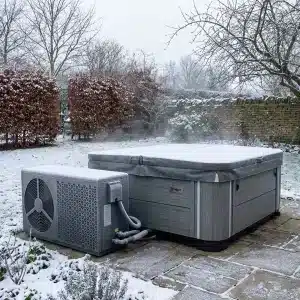
This is where technical engineering separates marketing from reality.
At this demanding winter condition, the SpaLine produces:
Heating power: 1.26 ~ 3.02 kW
Consumption: 0.39 ~ 1.45 kW
COP: 3.23 ~ 2.08
Very few manufacturers publish performance data at -10°C ambient with 38°C spa water.
Why?
Because many pool heat pumps are not designed to operate efficiently at those temperatures.
The iNHEAT SpaLine is a cold climate air source heat pump for hot tubs, built for year-round operation.
This makes it an ideal winter hot tub heating solution in the UK.
COP (Coefficient of Performance) determines how energy efficient a heat pump really is.
If the COP is 5:
For every 1kW of electricity consumed, 5kW of heat is delivered.
At realistic spa temperatures, the SpaLine maintains strong COP values — even at low ambient temperatures.
This translates into:
Lower energy bills
Reduced operating costs
More sustainable heating
Better long-term return on investment
If you’re searching for the most efficient heat pump for hot tubs, COP at 38°C is what you should be comparing — not maximum output at 26°C water.
When searching for the best heat pump for a hot tub in the UK, many buyers unknowingly compare spa-specific models against pool heat pumps.
At first glance, both might be labelled “7kW inverter heat pumps.”
But the engineering priorities are very different.
Here’s how they compare.
Pool Heat Pumps
Optimised for 24–28°C pool water
Performance figures often published at 26°C water
Not primarily engineered for continuous 38°C operation
iNHEAT SpaLine (Hot Tub Heat Pump)
Engineered specifically around 38°C spa temperature
Published data at Air 15°C / Water 38°C
Published data at Air -10°C / Water 38°C
Designed for high-temperature lift year-round
👉 This is critical. Hot tubs operate 10–12°C hotter than pools. That dramatically changes compressor load and efficiency.
Typical Pool Heat Pumps
Often tested in mild conditions
Many do not publish performance at -10°C
Efficiency drops significantly at low ambient temperatures
Some models rely heavily on electric backup heating in winter
iNHEAT SpaLine
Publishes sub-zero performance data
Maintains measurable output at Air -10°C / Water 38°C
Designed as a cold climate heat pump for hot tubs
Suitable for year-round UK spa use
If you want a true winter hot tub heating solution, sub-zero test data matters.
Pool Heat Pumps
Often advertise maximum COP at 26°C water
COP drops noticeably at 38°C
Efficiency claims may not reflect spa conditions
SpaLine Hot Tub Heat Pump
COP published at 38°C water temperature
Strong efficiency at Air 15°C / Water 38°C
Maintains usable COP even at Air -10°C
When trying to reduce hot tub running costs, COP at spa temperature is what determines your electricity bill — not maximum COP at pool temperature.
Pool Units
Seasonal operation focus
Larger water volumes
Lower temperature rise
Designed for summer dominance
Hot Tub-Specific Units (SpaLine)
High temperature lift (26°C → 38°C)
Continuous operation
Precise inverter modulation
Titanium heat exchanger for spa chemistry
Stable operation in shoulder and winter seasons
A spa heat pump must handle greater thermal stress and higher operating pressure.
That requires purpose-driven engineering.
A simple rule when choosing a spa heat pump in the UK:
If a manufacturer does not publish performance at 38°C water temperature, it is likely a pool-derived unit.
The iNHEAT SpaLine openly publishes:
Air 15°C / Water 38°C data
Air -10°C / Water 38°C data
Consumption ranges
COP ranges under spa conditions
That level of transparency is rare — and reflects specialist design.
Using a pool heat pump on a hot tub can result in:
Higher running costs
Reduced winter performance
Increased compressor strain
Lower real-world COP
Longer heat-up times
Choosing a dedicated air source heat pump for hot tubs ensures:
Optimised performance at 38°C
Lower long-term energy bills
Reliable winter heating
Stable, efficient inverter control
If your priority is:
✔ Heating a swimming pool in summer → a pool heat pump may suffice.
✔ Heating a hot tub year-round in the UK → you need a hot tub-specific heat pump.
The iNHEAT SpaLine is engineered around spa temperatures, not adapted to them.
And that difference shows in the Air 15°C / 38°C and -10°C / 38°C performance data.
Transparency builds trust.
If a manufacturer does not publish performance at realistic hot tub temperatures, you are making assumptions.
The SpaLine provides:
Verified sub-zero performance data
Published COP at spa temperatures
Real cold-climate metrics
Clear electrical consumption figures
This makes it one of the few genuinely hot tub-specific air source heat pumps on the market.
When comparing options, don’t just search:
“7kW heat pump UK”
Instead, look for:
Performance at 38°C water
Cold weather heating capability
Published -10°C data
COP at spa temperature
True inverter modulation
The iNHEAT SpaLine stands out because it is engineered around the real operating environment of a hot tub.
And the Air 15°C / 38°C and Air -10°C / 38°C performance figures demonstrate its technical capability.
If you want a genuine energy efficient hot tub heat pump designed for UK conditions, those numbers matter.